

GHK-Cu + BPC-157 + TB-500 Peptide Blend Description
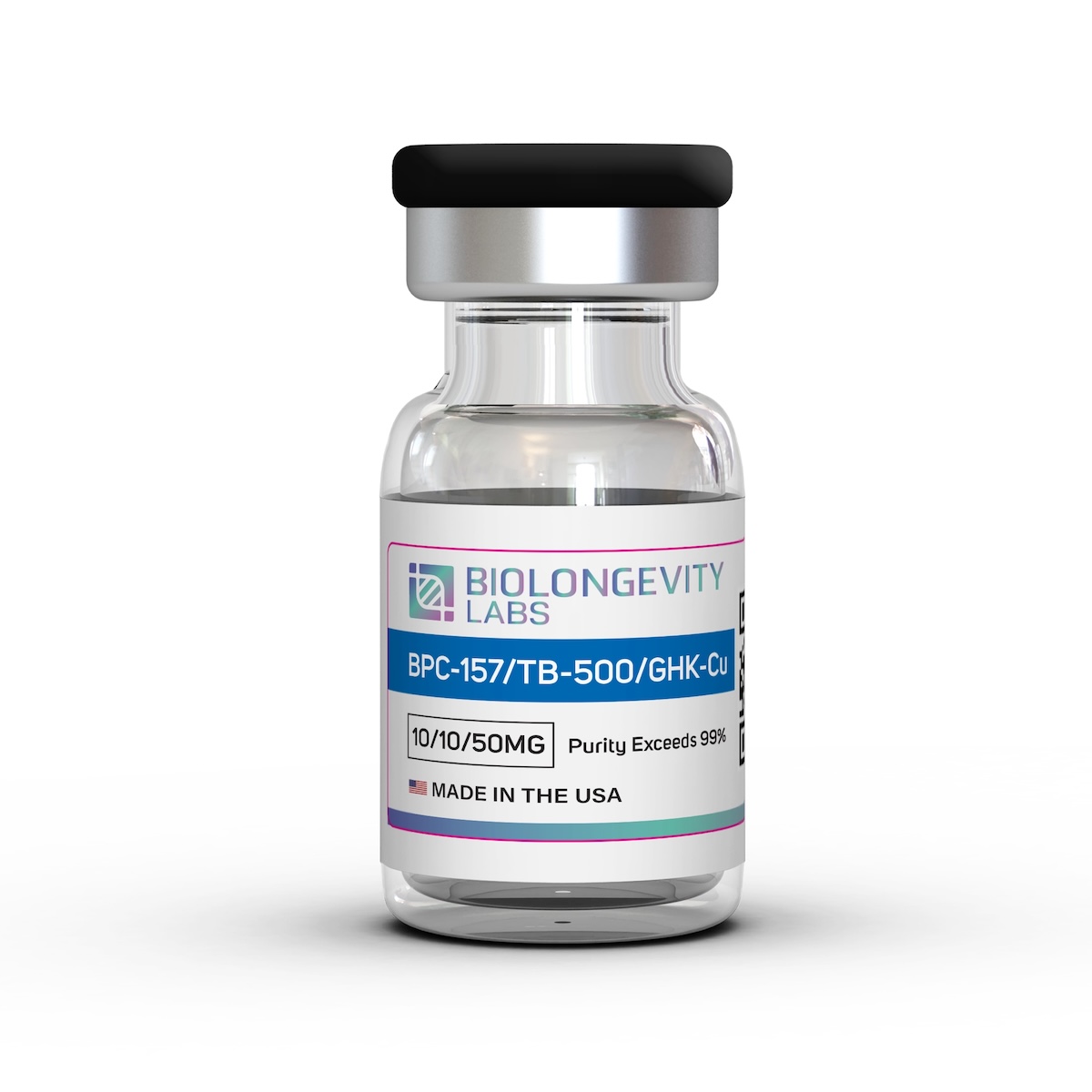
This multi-peptide preparation unites three widely researched regenerative peptides into a single vial for investigations that probe complementary pathways of tissue repair and remodeling.
- GHK-Cu is best known for up-regulating wound-healing genes and driving collagen, elastin, and angiogenic growth-factor expression.
- BPC-157 exhibits gastro-protective, tendon-/ligament-healing, and anti-inflammatory actions through modulation of nitric-oxide signaling, growth-factor receptors, and cytokine balance.
- TB-500 enhances cell migration and angiogenesis primarily via actin‐sequestering and integrin-linked pathways.
When combined, researchers can examine potential synergy across copper-mediated extracellular-matrix activation (GHK-Cu), cytoprotective/anti-inflammatory signaling (BPC-157), and actin-dependent cell-motility mechanisms (TB-500). Typical in-vitro or in-vivo models evaluate collagen deposition rates, angiogenic indices, or recovery timelines after controlled soft-tissue injury.
This is a 70 mg lyophilized blend containing 50 mg GHK-Cu, 10 mg BPC-157, and 10 mg TB-500 per vial.
Peptide Structures
GHK-Cu
- Sequence: Gly-His-Lys · Cu²⁺
- Molecular Formula: C₁₄H₂₄CuN₆O₄
- Molecular Weight: 403.9 g/mol
- PubChem CID: 378611
- CAS Number: 49557-75-7
- Synonyms: Copper peptide GHK, Cu-GHK, NSC 661251
BPC-157
- Sequence: Gly-Glu-Pro-Pro-Pro-Gly-Lys-Pro-Ala-Asp-Asp-Ala-Gly-Leu-Val
- Molecular Formula: C₆₂H₉₈N₁₆O₂₂
- Molecular Weight: 1419.5 g/mol
- PubChem CID: 9941957
- CAS Number: 137525-51-0
- Synonyms: PL-14736, Body-Protection Compound-157, Bepecin
TB-500 (Thymosin-β4 fragment)
- Sequence: Ac-Leu-Lys-Lys-Thr-Glu-Thr-Gln (Ac-LKKTETQ)
- Molecular Formula: C₃₈H₆₈N₁₀O₁₄
- Molecular Weight: 889.0 g/mol
- PubChem CID: 62707662
- CAS Number: 885340-08-9
- Synonyms: Thymosin-β4 fragment 17-23, TB-500 acetate, Ac-LKKTETQ
Lyophilized Peptides
All three peptides are supplied in a freeze-dried, filler-free state to maximize stability and preserve chemical integrity during refrigerated or frozen storage. Reconstitute with sterile solvent immediately prior to experimental use and store aliquots at ≤ –20 °C to prevent repeated freeze–thaw cycles.