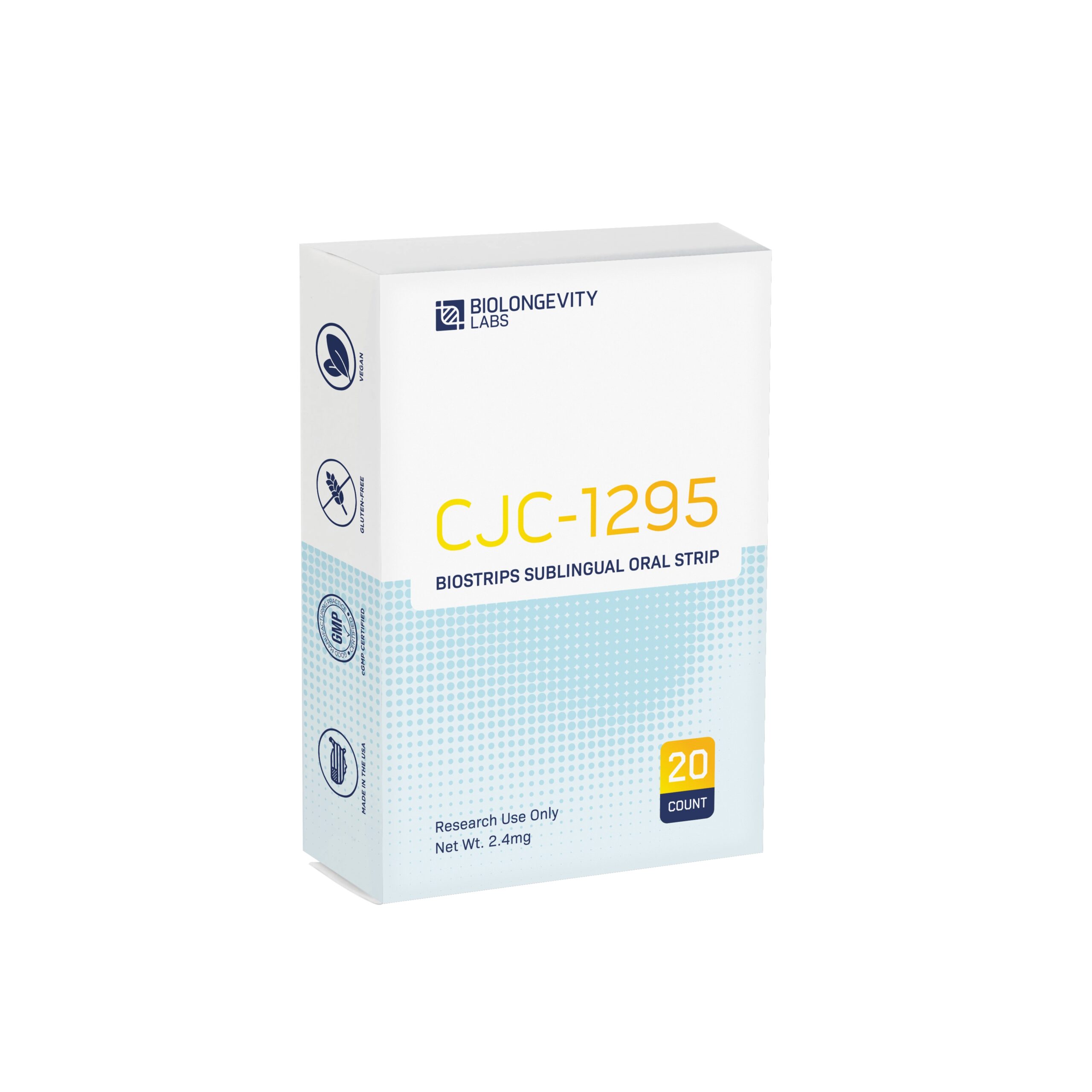


CJC-1295 Product Description
CJC-1295 is a modified version of GHRH (1-29), the shortest fragment of GHRH, a 44-amino-acid peptide produced in the hypothalamus. CJC-1295 binds to GHRHR on somatotroph cells in the anterior pituitary with high affinity, mimicking GHRH’s action. This binding activates the GHRHR, initiating intracellular signaling cascades.
Contains 20 buccal strips (150mcg) for research purposes.
CJC-1295 Peptide Structure
Molecular Formula: C152H252N44O42
Molecular Mass: 3367.9 g/mol
Pubchem CID: 56841945
Synonyms:
- 863288-34-0
- CJC-1295 No DAC
Research Areas:
- Albumin Binding
- IGF-1 Elevation
- Growth Hormone Pathways
CJC-1295 Research
CJC-1295, also known as Modified GRF 1-29, is a synthetic analog of growth hormone-releasing hormone (GHRH) that offers unique research opportunities for laboratories studying growth hormone pathways. The compound’s distinctive albumin-binding characteristics provide researchers with extended observation windows for mechanism studies.
Albumin Binding Mechanism
The primary research interest in CJC-1295 centers on its ability to form stable conjugates with serum albumin through its reactive maleimidopropionic acid group. This bioconjugation mechanism creates covalent bonds with free thiols on plasma proteins, offering researchers a model for studying protein-peptide interactions[1].
Laboratory studies demonstrate this binding strategy extends the compound’s detectable presence in circulation beyond 72 hours. This contrasts significantly with native GHRH’s very short detection window[2]. Research teams can leverage this extended timeframe for pharmacokinetic studies and mechanism investigations.
Growth Hormone Pathway
CJC-1295 functions as a selective GHRH analog that provides researchers with tools for studying anterior pituitary stimulation pathways. Laboratory investigations show the compound maintains natural pulsatile secretion patterns while allowing detailed observation of growth hormone release mechanisms[3].
Research data indicates a 4-fold increase in growth hormone area under the curve over 2-hour observation periods compared with native hGRF(1-29)[2]. Studies also demonstrate the peptide’s ability to increase basal growth hormone levels by 7.5-fold while preserving natural pulsatility patterns[3].
These findings offer research teams validated endpoints for studying growth hormone regulation and pituitary function in laboratory models.
Growth Hormone Deficiency
Preclinical research using GHRH knockout mouse models provides laboratories with established methodologies for studying growth hormone pathway restoration. Research demonstrates that once-daily administration protocols can normalize growth parameters, body weight, and length measurements in these models[4].
Laboratory investigations show the compound stimulates somatotroph cell proliferation and increases total pituitary RNA and GH mRNA expression. These findings suggest researchers can study pituitary function restoration in models with intact secretory capability but deficient GHRH signaling[4].
This research framework offers laboratories clear protocols for investigating growth hormone pathway interventions and measuring functional outcomes.
IGF-1 Research
Laboratory studies consistently demonstrate CJC-1295’s effects on insulin-like growth factor-1 (IGF-1) levels, providing researchers with measurable biomarkers. Research data shows mean plasma IGF-1 concentrations increase 1.5- to 3-fold for 9-11 days following single administration in study models[5].
Multiple administration studies reveal mean IGF-1 levels remain elevated above baseline for up to 28 days[5]. This sustained elevation offers research teams extended observation windows for studying IGF-1’s role in mediating growth hormone effects[3].
These findings provide laboratories with validated biomarkers and timeframes for investigating growth hormone downstream signaling pathways.
Research Methodologies and Applications
Laboratory Study Opportunities:
- Pharmacokinetic Studies – Extended half-life enables detailed absorption and distribution research
- Mechanism Investigations – Albumin binding provides models for protein-peptide interaction studies
- Biomarker Research – IGF-1 elevation offers measurable endpoints for pathway studies
- Pituitary Function Studies – Cell proliferation effects enable organoid and tissue culture research
Research Models:
- In vitro pituitary cell culture systems
- Ex vivo tissue preparation studies
- Animal model investigations with established protocols
- Bioconjugation mechanism studies
Research Considerations
Laboratories investigating CJC-1295 benefit from its well-characterized pharmacokinetic profile and established research methodologies. The compound’s albumin binding mechanism offers unique opportunities for studying bioconjugation strategies and extended-release peptide design.
Research teams should note the compound’s selective GHRH receptor activity and preserved pulsatile patterns when designing experimental protocols. The sustained IGF-1 elevation provides reliable biomarkers for mechanism studies and pathway investigations.
References:
- Timms, M., Bailey, S., Steel, R., Forbes, G., & Ganio, K. (2018). An immuno polymerase chain reaction screen for the detection of CJC-1295 and other growth-hormone-releasing hormone analogs in equine plasma. Drug testing and analysis, 11 6, 804-812. https://doi.org/10.1002/dta.2554.
- Robitaille, M., Pham, K., Pellerin, I., Bridon, D., Benquet, C., Jetté, L., Paradis, V., Léger, R., Thibaudeau, K., & Van Wyk, P. (2005). Human growth hormone-releasing factor (hGRF)1-29-albumin bioconjugates activate the GRF receptor on the anterior pituitary in rats: identification of CJC-1295 as a long-lasting GRF analog. Endocrinology, 146 7, 3052-8. https://doi.org/10.1210/EN.2004-1286.
- Ionescu, M., & Frohman, L. (2006). Pulsatile secretion of growth hormone (GH) persists during continuous stimulation by CJC-1295, a long-acting GH-releasing hormone analog. The Journal of clinical endocrinology and metabolism, 91 12, 4792-7. https://doi.org/10.1210/JC.2006-1702.
- Alba, M., Castaigne, J., Fintini, D., Salvatori, R., Lawrence, B., Frohman, L., & Sagazio, A. (2006). Once-daily administration of CJC-1295, a long-acting growth hormone-releasing hormone (GHRH) analog, normalizes growth in the GHRH knockout mouse. American journal of physiology. Endocrinology and metabolism, 291 6, E1290-4. https://doi.org/10.1152/AJPENDO.00201.2006.
- Gagnon, C., Lawrence, B., Frohman, L., Teichman, S., Castaigne, J., & Neale, A. (2006). Prolonged stimulation of growth hormone (GH) and insulin-like growth factor I secretion by CJC-1295, a long-acting analog of GH-releasing hormone, in healthy adults. The Journal of clinical endocrinology and metabolism, 91 3, 799-805. https://doi.org/10.1210/JC.2005-1536.